
Your needs, this model
Does it fit your priorities?
What does the AONIC 50 Gen 2 UC package add over the standard Black headphones?
The U.S. standard SBH50G2-BK page lists a case and two cables. The separate AONIC50-UC page adds an SBD1-UC USB-C Bluetooth adapter and Teams certification. Confirm that exact package code; do not assume the adapter is included with the standard SKU.
Explore this need in the finder →Can I plug the UC adapter into a phone or USB hub?
No. Shure's UC setup guide says the adapter must connect directly to a computer; hubs and phone ports are unsupported. It is intended for desktop Teams calls, with the headphones powered on and Shure SBD1-UC selected as the Teams speaker and microphone. The guide lists support for the two latest Windows and macOS versions.
Can the UC package's USB Hi-Res audio keep ANC enabled?
No. The headphone guide explicitly excludes ANC, Spatializer, EQ and the headphone microphone in USB Hi-Res Listening mode. That digital-audio path differs from the supplied SBD1-UC adapter's Bluetooth link and from the 3.5 mm analog input.
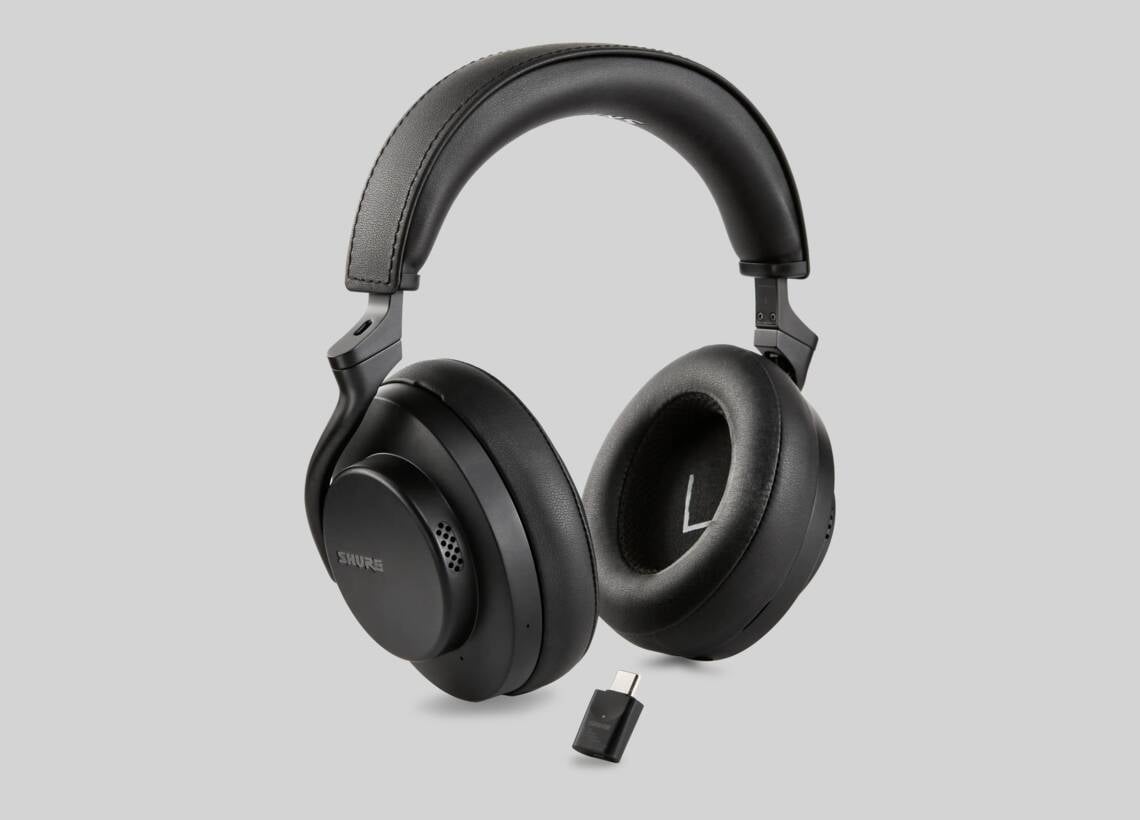
Explore this need in the finder →The AONIC 50 Gen 2 UC is not just a relabelled Black AONIC 50: Shure gives the Teams-certified U.S. package a separate SKU, AONIC50-UC, and includes an SBD1-UC USB-C Bluetooth adapter. The headphone body uses the same MH36458 model as the standard Gen 2, but the adapter creates a distinct desktop connection route. Shure's U.S. page currently labels this package “Coming Soon,” so this is a product reference, not a purchase-ready recommendation. This is a source-based assessment, not a hands-on call or listening test.
The added adapter is for a specific desk workflow
Shure describes the adapter as pre-paired to the headphones. For Microsoft Teams, its guide says to insert the SBD1-UC directly into a computer's USB-C port, turn on the headphones, then select “Shure SBD1-UC” as the Teams speaker and microphone. The adapter is not documented for a phone port or USB hub. Shure lists support for the two latest versions of Windows and macOS, so the exact computer, port and software remain purchase checks rather than assumptions.
The guide also gives a direct Bluetooth route for a phone, and its multipoint instructions describe reconnecting the desktop adapter while the phone remains connected. That makes the adapter package useful to assess for a phone-plus-computer setup, but not because it mixes two sources. The headphone inputs alternate; a second device connection is a switching capability, not a promise of simultaneous music streams. The UC arrangement adds an adapter-to-headphone Bluetooth hop, while the computer reaches the adapter over USB-C.
The headphone controls and cable modes still matter
The underlying headphones retain the Gen 2's adjustable Light, Moderate, Max and MaxAware ANC modes, separate Environment Mode, app-controlled DSP, and the two-device Bluetooth capability. Shure says the device can retain PLAY settings independent of the audio source. The UC guide's six-microphone and beamforming claims are manufacturer descriptions, not an independent call-quality test, and the Teams button's function is tied to a running Teams client.
The UC page lists both the 3.5 mm analog cable and USB-C cable alongside the adapter. These are not synonyms for the Teams dongle route. The manual's USB Hi-Res Listening mode disables ANC, Spatializer, app EQ, switch customization and the headphone microphone; do not select that high-resolution digital mode when ANC or the headset mic is essential. Shure's documentation supports powered analog ANC by describing DSP persistence across source connections and separately documenting the ANC controls, but does not give a wired ANC runtime. It also does not confirm passive analog playback after power-off.
Keep the runtime and availability claims narrow
Shure lists up to 45 hours for the headphones, but the reviewed documentation does not tie that general figure to ANC-on use or the UC adapter route. This assessment leaves the ANC-on runtime unconfirmed instead of converting the headline into a numeric guarantee. Shure's manual lists 334 g for the headphone unit; that figure cannot establish whether its seal, cup clearance or clamp will suit a particular person.
The exact package distinction is consequential: the standard U.S. SBH50G2-BK page lists a case and two cables, while AONIC50-UC adds the SBD1-UC adapter and Teams certification. The UC page currently says Coming Soon, not that a shipping date or current stock exists. I therefore keep this review visible as a reference but out of the buying matches and central purchase-page list until Shure confirms U.S. availability. Recheck the package code and adapter before relying on any seller description.
Who should compare it with the standard SKU
Someone who only needs direct phone Bluetooth, multipoint, analog audio or USB digital audio should compare the standard Black AONIC 50 Gen 2 assessment first; its page lists the base headphone package without the SBD1-UC. Someone who needs a desktop Teams USB-C host route should look for the exact AONIC50-UC bundle, confirm availability and OS support, and verify that the adapter is actually included. Neither SKU is supported here as a substitute for a personal fit trial or measured noise-cancellation comparison.
Key specifications
Key details at a glance
| Fit | Over-ear / around-ear |
|---|---|
| Active noise cancellation | Yes |
| Headset weight | 334 g |
| Bluetooth version | 5 |
| Bluetooth audio codecs | aptX / aptX HD / aptX Adaptive / SBC / AAC / LDAC |
| Simultaneous Bluetooth devices | 2 |
| Analog audio input | 2.5 mm headphone input to 3.5 mm audio source via included 1.5 m cable |
| Analog cable included | Yes |
| In the box | Premium zippered carrying case / 1 m USB-C to USB-A charging/communication/audio cable / 1.5 m 2.5 mm-to-3.5 mm analog audio cable / SBD1-UC USB-C Bluetooth adapter |
Use the exact model’s instructions for operating limits, supplied equipment and version differences.
Sources for this review
Sources for this assessment
Check this model against your routine
Use the finder to test documented connection, ANC and battery requirements together. A match is not proof of personal comfort or measured quiet.