
Your needs, this model
Does it fit your priorities?
Can I keep my phone and computer connected at the same time?
Bose's QCUH2 Owner's Guide says the headphones can save up to six devices and keep two active Bluetooth connections. They play one audio stream at a time, so switching means pausing one source and starting the other; this is not simultaneous mixing. Multipoint can be managed in the Bose app.
Explore this need in the finder →Will a cable keep playing if I switch the headphones off or the battery is empty?
No. Bose's QCUH2 guide requires the headphones to be powered on for the 3.5 mm analog mode. It does not document passive power-off listening; if power is depleted, the guide directs you to provide USB-C power and then switch the headphones on. The same guide says ANC is unavailable while powered off.
Explore this need in the finder →Do Moonstone Blue and Midnight Violet have different battery ratings or included kit?
Bose's exact selected-variant responses for the two KidSuper IDs list the same package, fit/material fields, dimensions and QCUH2 capabilities. The product page gives up to 30 hours with Immersive Audio off and 23 with it on. The visible hand-painted design differs, but the captured specifications do not document a functional or package difference between these two variants.
Explore this need in the finder →Bose × KidSuper · U.S. collaboration · two exact color variants assessed
The Bose × KidSuper QuietComfort Ultra Headphones (2nd Gen) are a separate collaboration, not a standard QCUH2 color option. Bose's U.S. product page lists two hand-painted designs: Moonstone Blue, variant QCUH2-HEADPHONEARN-KID-MSBL-WW (item 890101-0010), and Midnight Violet, variant QCUH2-HEADPHONEARN-KID-MDVIO-WW (item 890101-0020). I checked both exact selected-variant records and their manufacturer images. The specifications and box contents shown for these two finishes match; the visible artwork differs. This is a document-based assessment, not a claim of listening, ownership, wear, or comparative testing.
Two verified designs, one KidSuper product family
The official U.S. product page describes two distinct hand-painted designs and links them to the QCUH2 second-generation headphone platform. The Moonstone Blue image shows colorful portrait artwork on a pale blue shell; Midnight Violet has a different purple illustration. These are useful exact-edition checks because ordinary Bose QCUH2 Black, the KidSuper versions, and the Thom Browne version have different item identities. Do not accept a listing title alone as proof that the pictured or shipped product is the edition you chose.
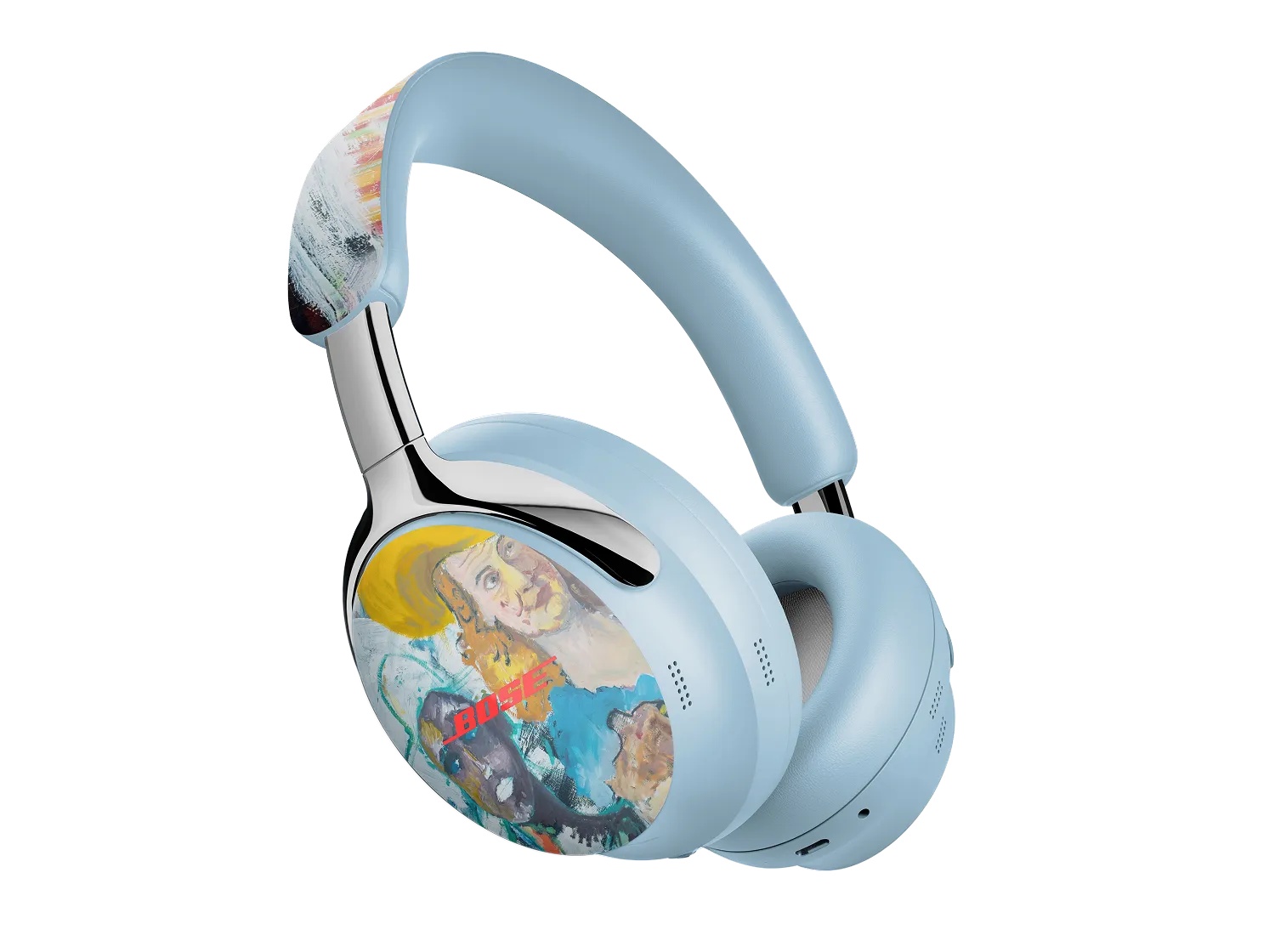
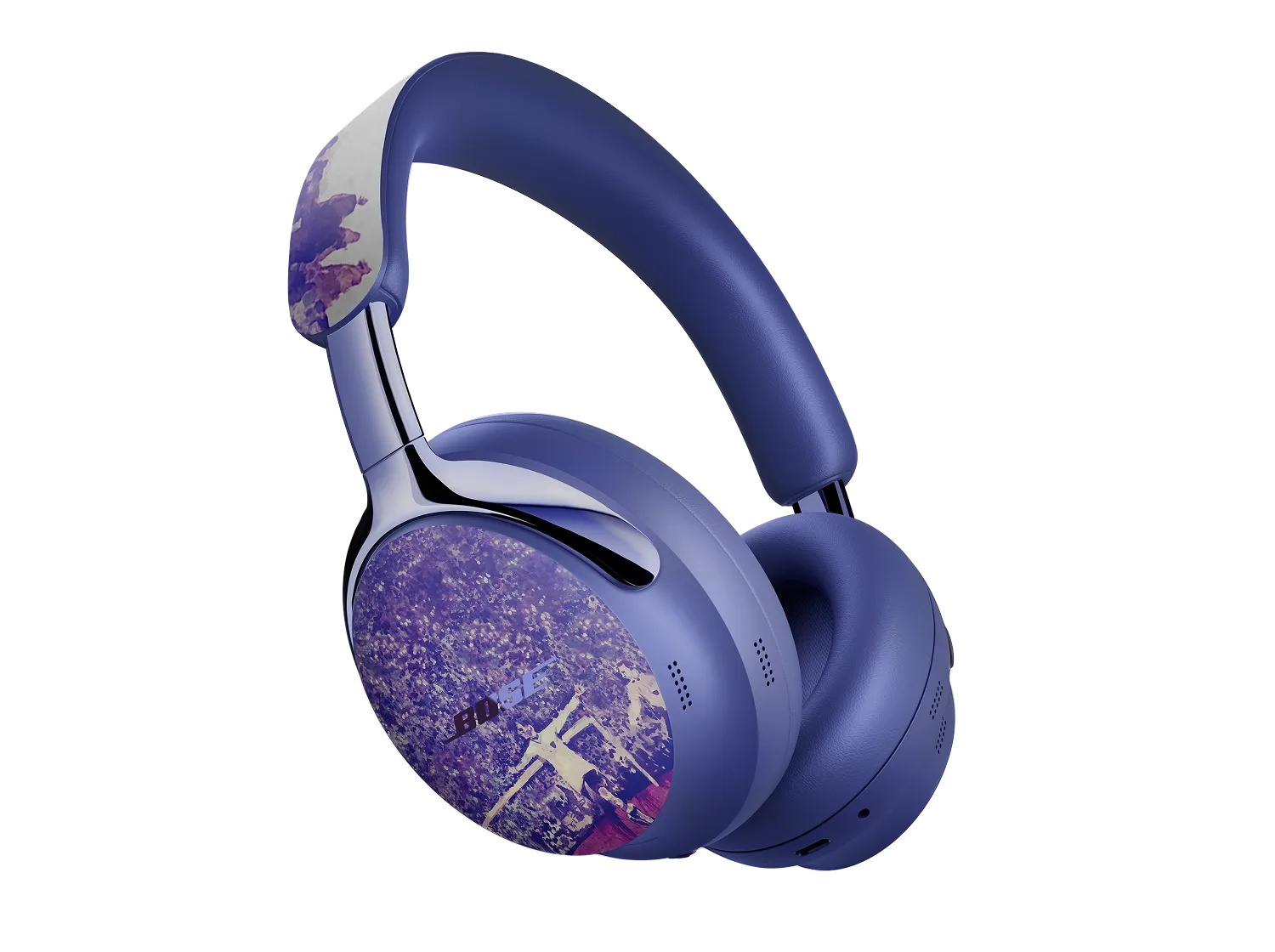
For both exact variants, Bose's selected-variant data reports the same around-ear fit, removable protein-leather cushions, dimensions and listed 0.583-pound (about 264-gram) headphone weight. Each page lists the same carry case, 3.5 mm-to-2.5 mm analog cable, 39-inch USB-C cable and safety sheet. I found no documented function or included-kit change between the two finishes; the review therefore covers both variants together, while keeping their SKUs and images separate.
Noise modes and a maximum battery figure
Bose describes active noise cancellation, Aware mode, Immersive Audio and Cinema mode for this generation. Its mode guide explains that Aware with ActiveSense can increase cancellation around sudden louder sounds; that is a mode description, not a measurement showing what will be quiet for a particular wearer. Bose advertises up to 30 hours with Immersive Audio off and up to 23 hours when it is on. The QCUH2 Owner's Guide's test conditions matter: volume, source, settings and use can change actual runtime, so neither figure predicts a long flight or a particular person's daily battery life.
Bluetooth switching is not two-source mixing
The model-specific Owner's Guide says the headphones can save up to six devices and keep two active Bluetooth connections. They play one audio stream at a time; to switch, pause one device and begin playback on the other. Calls can arrive from a connected phone, but two active connections should not be confused with blending music from two devices. For these two separate KidSuper variants, the selected-variant records identify Bluetooth connections but leave Bluetooth version, range and codec fields blank. I therefore do not transfer the standard-color launch specifications to these exact collaboration SKUs; confirm a particular codec requirement with Bose or the retailer before relying on it.
Powered analog and digital USB-C are different routes
The listed analog cable connects a 3.5 mm source to the headphones' 2.5 mm input, but the guide requires the headphones to be powered on. It is not passive, battery-free playback: when switched off, ANC is unavailable, and the analog connection does not provide calls, microphone pickup, or headset media controls. If the battery is depleted, Bose directs the user to provide USB-C power and turn the headphones on. USB-C audio is a separate digital mode; Bose documents 16-bit audio at 44.1 or 48 kHz from compatible source material, and the guide covers listening while charging. Confirm that the host device can act as a USB audio source rather than assuming every USB-C port will behave the same way.
What this collaboration does—and does not—establish
The visual collaboration may matter if the art is the reason to choose it; the exact product pages do not document a sound, ANC, battery or connection advantage over the ordinary second-generation platform. The two variant records share the same function fields and accessory list, but that does not make them the same retail SKU as standard Black or the separately marketed Thom Browne edition. The fit is around-ear/circumaural by Bose's classification. That label cannot predict pressure, heat, glasses compatibility, seal, or comfort over a long session.
Who should shortlist it—and what to verify
It is a documented fit for a buyer who wants Bose's second-generation ANC modes, phone-and-computer Bluetooth switching, USB-C audio, and one of the KidSuper designs. It is a poor fit for a routine that requires passive cable listening with the headset powered off. Before buying, compare the exact item ID and the pictured finish, confirm the full package, check source-device compatibility, and read the seller's return terms. Bose's maximum runtime and feature list do not establish personal comfort, cancellation strength, or the artwork's appearance under every screen or room light.
Key specifications
Key details at a glance
| Fit | Over-ear / around-ear |
|---|---|
| Active noise cancellation | Yes |
| Maximum continuous music playback (ANC on) | 30 hours |
| Headset weight | 264 g |
| Simultaneous Bluetooth devices | 2 |
| Analog audio input | 3.5 mm source to 2.5 mm headphone connection |
| Analog cable included | Yes |
| Passive analog playback with headset off | No |
| Waterproof | No |
| In the box | Carry case / 3.5 mm-to-2.5 mm audio cable / USB-C-to-USB-C cable (39 in) / Safety sheet |
Use the exact model’s instructions for operating limits, supplied equipment and version differences.
Sources for this review
Sources for this assessment
- Bose × KidSuper QuietComfort Ultra Headphones (2nd Gen), Moonstone Blue U.S. product page
- Bose U.S. selected-variant details for KidSuper Moonstone Blue (QCUH2-HEADPHONEARN-KID-MSBL-WW)
- Bose × KidSuper QuietComfort Ultra Headphones (2nd Gen), Midnight Violet U.S. selected product page
- Bose U.S. selected-variant details for KidSuper Midnight Violet (QCUH2-HEADPHONEARN-KID-MDVIO-WW)
- Bose Owner's Guide: QuietComfort Ultra Headphones (2nd Gen), model QCUH2-HEADPHONEARN
- Bose launch release: QuietComfort Ultra Headphones (2nd Gen)
- Bose support: using modes on QuietComfort Ultra Headphones (2nd Gen)
- CPSC Download All Recalls export (scoped search, not a clearance)
Check this model against your routine
Use the finder to test documented connection, ANC and battery requirements together. A match is not proof of personal comfort or measured quiet.