
Your needs, this model
Does it fit your priorities?
Can a phone and laptop stay connected together?
The TAH9505 manual documents pairing to two devices and switching music between them; it says music is heard from one device at a time while the second can handle a call. That fits a phone-and-computer handoff, not simultaneous stream mixing.
Explore this need in the finder →What is its ANC-on Bluetooth runtime rating?
Philips lists up to 27 hours with ANC enabled and the same 27-hour figure with ANC disabled. The 27-hour ANC-on value meets that numeric floor, but the manufacturer calls it approximate and it is not a forecast for an older battery.
Explore this need in the finder →Does its included cable prove powered-off listening?
Philips includes a 2.5-to-3.5 mm cable and the manual describes wired line-in use, but neither the manual nor the U.S. leaflet confirms whether sound continues with power off or whether ANC remains active while cabled. Treat those behaviors as unknown.
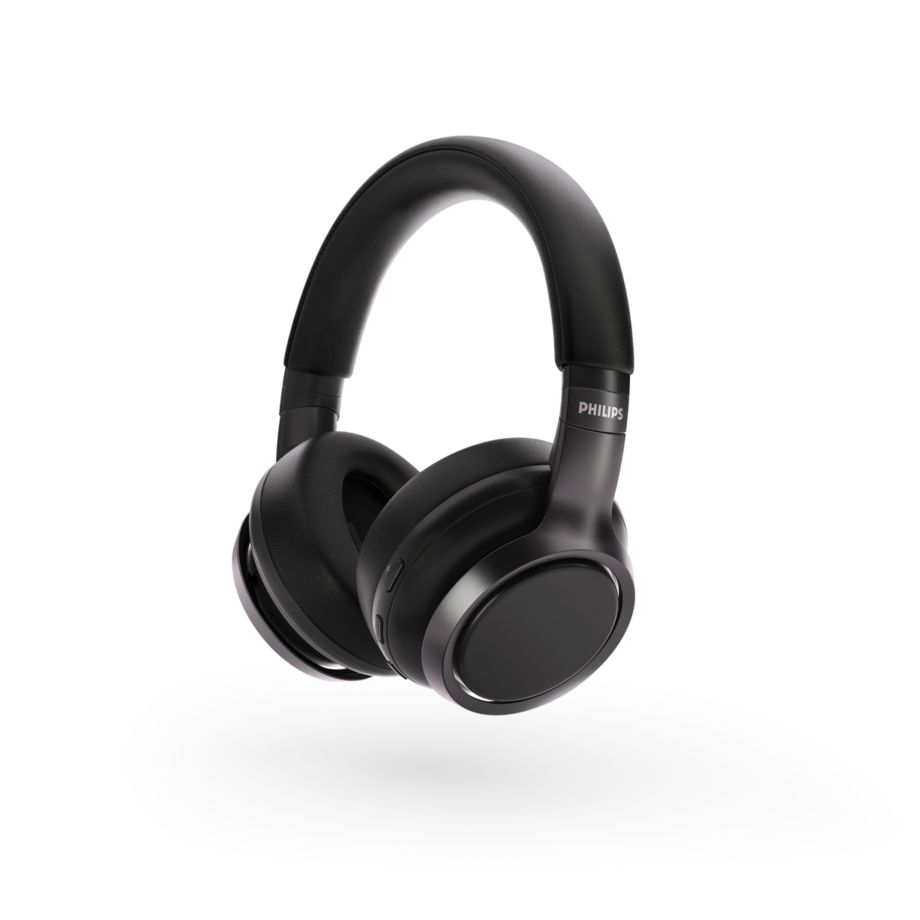
Explore this need in the finder →The Black U.S. Philips TAH9505BK/00 is an earlier over-ear ANC headphone with one unusually clear comparison point: Philips rates Bluetooth music at up to 27 hours whether ANC is on or off, and its manual documents two-device multipoint. The included analog cable is real, but the U.S. sources do not say whether ANC or playback after power-off works through it. This is a source-based assessment of the exact model, not a listening test or measurement of noise reduction.
Start with the exact U.S. model
Philips' U.S. product and support pages identify TAH9505BK/00, and the manufacturer currently labels that exact item discontinued. Its support page links a localized U.S. commercial leaflet and quick-start guide; an official Philips user manual identifies the TAH9505 family. The leaflet calls it a closed-back, headband, over-ear design with 40 mm drivers. That makes it relevant to an over-ear ANC comparison, but the product status means an old seller listing still needs a condition, warranty and return check. A manufacturer's archived product page does not prove current stock.
Twenty-seven hours in either Bluetooth ANC state
The U.S. leaflet lists up to 27 hours of music with ANC on and the same maximum with ANC off. It also gives a four-hour charge time and says a 15-minute quick charge adds up to five hours. Those are manufacturer ratings, not results from this review. The ANC-on and ANC-off figures are equal in the published table, so there is no reason to substitute a higher ANC-off number when cancellation is essential. Still, Philips describes battery life as approximate; calls, volume, settings, device behavior and an older battery can make actual use differ.
Philips describes hybrid noise cancellation, adaptive modes and an Awareness setting, while the leaflet lists ANC and ambient sound features. These details establish available controls, not how much aircraft, traffic or office sound a particular wearer will hear. I have no independently measured attenuation result for this model. The over-ear seal and individual fit therefore remain important, especially if glasses, ear clearance or long sessions affect your comfort.
Multipoint means switching, not mixing
The TAH9505 supports Bluetooth 5.0 with AAC and SBC listed, plus a two-device multipoint connection. Its manual explains the practical limit: music comes from one device at a time, while another connected device can handle a phone call. If a call arrives on the second device during audio from the first, the first playback pauses and can resume after the call. That is a useful documented pattern for a laptop and phone, but it is not two music streams blended together. Pairing both sources and host behavior still matter, and codec support depends on the sending device.
Philips' product copy describes the ANC microphones in one way, while the U.S. leaflet's specification table lists a different ANC microphone count. Because those descriptions do not reconcile cleanly, this assessment leaves the exact ANC-microphone count unstated. That discrepancy does not change the documented existence of ANC or multipoint, but it is a reason not to turn component counts into a performance claim.
The cable is useful, but the mode boundary matters
The leaflet lists a 2.5 mm headphone socket and an included 1.2 m cable with a 2.5 mm headset end and 3.5 mm source end. The manual says the supplied lead can connect the headphones to an external audio device and notes that the function keys are disabled during line-in use. That is enough to describe an analog route, but not to say that ANC remains active on it or that sound continues with the headphone switched off or out of battery. The 27-hour rating belongs to Bluetooth music, not this cable arrangement.
The same manual identifies USB-C as charging-only. Do not treat a charging port as a digital audio input. If wired ANC, passive playback or USB audio is a must-have, confirm it for the exact unit with an explicit source rather than inferring from the included cable or connector shape.
Weight and original package are reference points
Philips lists the headphone at 250 g and describes the cups as over-ear, closed-back and flat-folding, with synthetic-leather ear coupling. The box list includes a hard carrying case, the analog lead, a 500 mm USB-C charging cable, an airplane adapter and quick-start guide. These are useful checks against a seller's exact offer; they do not establish that an older or refurbished box is complete. The weight and material label also cannot tell you whether clamp, heat, seal or cushion shape will suit your head.
How it differs from nearby Philips models
Philips' separate TAH8505BK/00 and TAPH805BK/27 pages also describe over-ear ANC headphones, but their exact U.S. documents rate 25 hours with ANC on rather than TAH9505's 27 hours. The TAH9505 manual specifically documents two-device switching; I did not find equivalent multipoint evidence in the reviewed TAH8505 or PH805 manuals. All three product pages mark their exact U.S. models discontinued, so these comparisons are about documented capabilities, not availability or quality ranking.
Keep the TAH9505BK/00 on a shortlist if you want a sourced over-ear Bluetooth ANC plan, two devices connected for switching, and a 27-hour maker maximum. Treat cable power behavior as unknown, and check the precise model code, package, battery condition and return terms before choosing an older offer. No hands-on testing, personal ownership, comfort rating, measured cancellation result, live price or stock claim is made here; exact-model recall screening remains open.
Primary sources: Philips' U.S. TAH9505BK/00 product page, U.S. support page, U.S. commercial leaflet and TAH9505 user manual.
Key specifications
Key details at a glance
| Fit | Over-ear / around-ear |
|---|---|
| Active noise cancellation | Yes |
| Maximum continuous music playback (ANC on) | 27 hours |
| Maximum continuous music playback (ANC off) | 27 hours |
| Headset weight | 250 g |
| Bluetooth version | 5.0 |
| Bluetooth audio codecs | AAC / SBC |
| Simultaneous Bluetooth devices | 2 |
| Analog audio input | 2.5 mm headphone socket with the included detachable 1.2 m 2.5-to-3.5 mm stereo cable |
| Analog cable included | Yes |
| Approximate charge time | 4 hours |
| In the box | Hard carrying case / 1.2 m 2.5-to-3.5 mm stereo audio cable / USB-C charging cable, 500 mm / Airplane adapter / Quick start guide |
Use the exact model’s instructions for operating limits, supplied equipment and version differences.
Sources for this review
Sources for this assessment
Check this model against your routine
Use the finder to test documented connection, ANC and battery requirements together. A match is not proof of personal comfort or measured quiet.