
Your needs, this model
Does it fit your priorities?
Can the PXC 550 keep my phone and laptop connected while ANC is on?
The PXC 550 manual says it reconnects to the last two connected Bluetooth devices and can store up to eight pairings. The headphone plays audio from one source at a time, so this is switching between links rather than mixing both streams. Its 20-hour specification is for Bluetooth with NoiseGard ANC activated.
Explore this need in the finder →Will the PXC 550 keep NoiseGard active through the included cable?
Yes, the manual describes active cable mode when the headset has sufficient battery and says NoiseGard is enabled in that arrangement. The manual's 30-hour figure is for cable use with only NoiseGard activated; it is not the separate 20-hour Bluetooth-plus-ANC figure. Connecting the 2.5 mm headset plug disables Bluetooth.
Explore this need in the finder →Can I still listen through a cable if the battery is empty?
The instruction manual identifies passive mode when the audio cable is connected with an empty battery. NoiseGard ANC is inactive in that passive mode; the powered cable ANC route requires sufficient battery charge.
Explore this need in the finder →Does the 30-hour rating apply to Bluetooth ANC?
No. The manual distinguishes 20 hours with Bluetooth and NoiseGard on from 30 hours when using the audio cable and only NoiseGard is activated. Neither figure predicts the runtime of a used unit with an aged battery.
Explore this need in the finder →The original PXC 550 Wireless is worth comparing only when you are looking at the exact U.S. Article No. 506514 and can inspect the condition of an older headset. Its useful distinction is not a single “wired” label: the manual separates Bluetooth ANC, powered analog ANC, passive cable listening with an empty battery, and digital USB audio.
Match the name and generation first
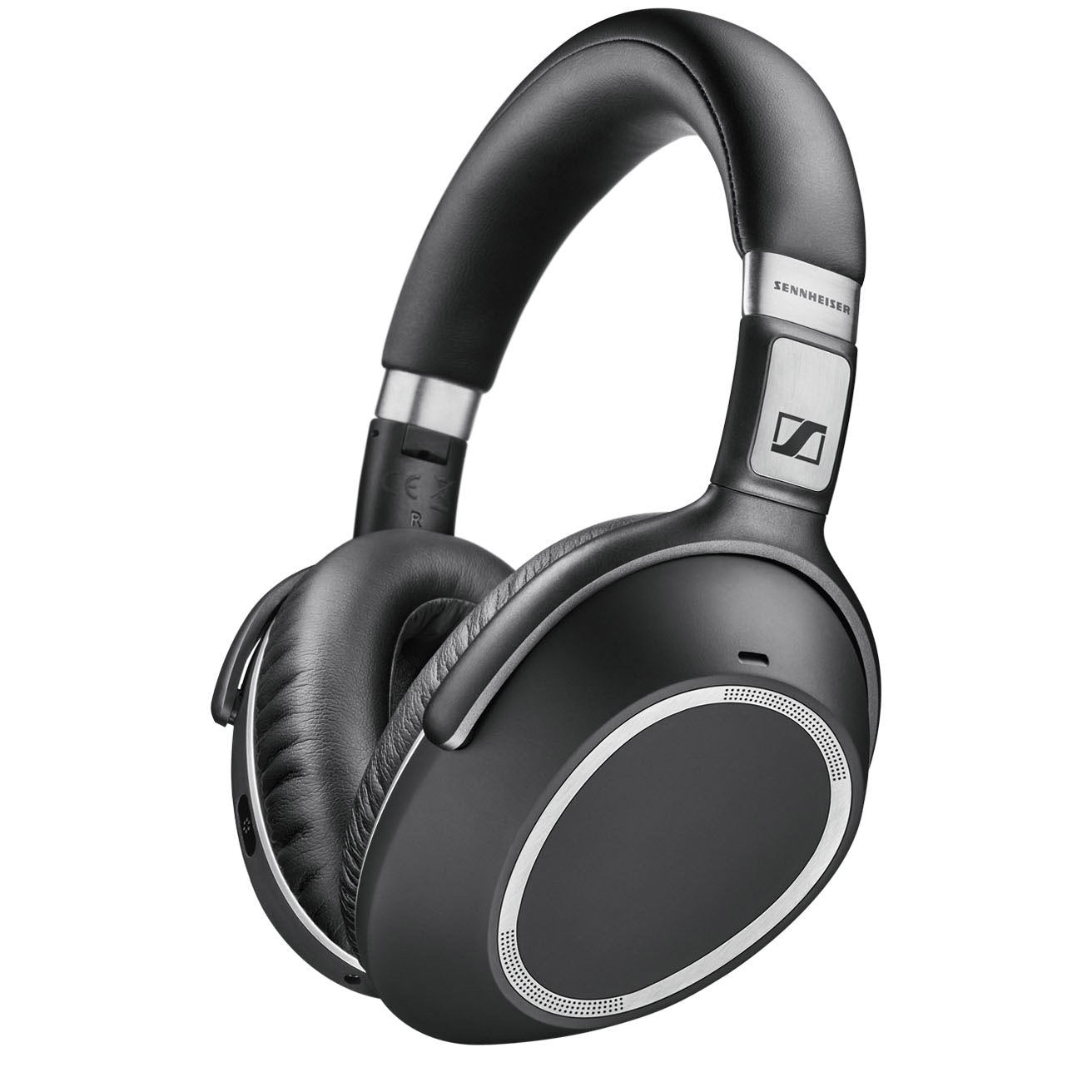
Sennheiser's U.S. page identifies this as the PXC 550 WIRELESS, Article No. 506514, and now marks it end of life. Do not confuse it with the PXC 550-II: that is a separate U.S. Article No. 508337 with a different product record and manual. The original manual describes a closed, around-ear design, a 227 g weight and Bluetooth 4.2. These specifications help compare form and connectivity; they do not tell you whether the cushion seal or headband will suit your own ears and glasses.Bluetooth ANC and two-device switching
The original PXC 550's manual describes adaptive NoiseGard ANC and a four-microphone cancellation system. It can attempt to reconnect to the last two Bluetooth devices, while its player handles one audio source at a time. That is a useful phone-and-computer switching arrangement, not a promise that two streams will mix. The published 20-hour operating figure applies when Bluetooth and NoiseGard are both active. Treat it as a manufacturer maximum for that mode, not a real-world runtime, and do not transfer the cable figure to Bluetooth. The headset's control layout also reflects its generation: right-cup touch gestures, a Bluetooth switch and the NoiseGard control rather than a modern app-first interface. Sennheiser's current U.S. compatibility page still lists the PXC 550 among Smart Control-compatible products, despite noting that the app does not generally support headphones released before 2018. That is useful context, not a guarantee that every current phone, operating system or app version will behave as a shopper expects. Confirm the exact device and setup you intend to use.Three cable states, not one
For powered analog listening, the included cable plugs into the headphone's 2.5 mm input and a 3.5 mm source. Connecting it disables Bluetooth. With sufficient battery and the headset on, the manual says the active NoiseGard cancellation remains available. The maker's 30-hour figure belongs to cable mode with only NoiseGard activated; it is a different statement from the 20-hour Bluetooth-plus-ANC rating. It should not be presented as 30 hours of Bluetooth ANC or as a present-day battery promise. The same manual gives the PXC 550 a separate passive cable route: if the battery is empty, audio can play with the cable but NoiseGard is inactive. That distinction matters if a no-charge fallback is essential. The fact that a cable fits the jack does not mean ANC can run without power. In a third route, the micro-USB cable can carry computer audio while charging; that is digital USB audio, not a 2.5 mm analog connection. The accessible operating documents do not assign that USB arrangement a separate ANC runtime.What makes an older offer a careful purchase
The manufacturer manual lists a carry case, a 2.5 mm-to-3.5 mm audio cable with an answer/end button, a micro-USB charging lead, an in-flight adapter, a 3.5 mm-to-6.3 mm adapter and printed quick and safety guides. A used set may no longer include those pieces. Inspect the headphone jack and cable latch, charging port, ear pads, hinge movement and whether the headset actually accepts and retains a charge. A manual-listed accessory package is not evidence about any specific seller's carton. Age is the major practical limitation. The manual's 20- and 30-hour numbers are factory ratings, not a forecast for a unit whose battery may have aged in storage or through use. Sennheiser's page says the model is end of life, so do not mistake a legacy product page or old list price for current stock, a warranty or a reliable repair path. Ask for a return option that covers battery faults and confirm the exact Article No. rather than relying on “PXC 550” in an offer title. This is a research-based assessment of documented configurations, not a listening test. The maker explains ANC as especially useful for steady noise and notes that speech or higher-frequency sounds can remain audible; neither that description nor the ANC label is an independent reduction measurement. Consider how the cups seal around your ears and whether your sources expose the right jack before prioritizing this model over a newer reference.Documents checked
Identity and lifecycle: Sennheiser U.S. product page. The operating details above are from the PXC 550 Wireless manufacturer instruction manual, publication A02; the current official PDF endpoint returned not found during this research cycle. Sennheiser's current Smart Control compatibility page separately lists the PXC 550.
Key specifications
Key details at a glance
| Fit | Over-ear / around-ear |
|---|---|
| Active noise cancellation | Yes |
| Maximum continuous music playback (ANC on) | 30 hours |
| Headset weight | 227 g |
| Bluetooth version | 4.2 |
| Bluetooth audio codecs | aptX |
| Simultaneous Bluetooth devices | 2 |
| Analog audio input | 2.5 mm headset input; included cable terminates in 3.5 mm source plug |
| Analog cable included | Yes |
| Passive analog playback with headset off | Yes |
| Approximate charge time | 3 hours |
| In the box | Carry case / 2.5 mm-to-3.5 mm analog audio cable with answer/end button / USB cable with micro-USB connector / In-flight adapter / 3.5 mm-to-6.3 mm adapter / Quick Guide / Safety Guide |
Use the exact model’s instructions for operating limits, supplied equipment and version differences.
Sources for this review
Sources for this assessment
- Sennheiser U.S. PXC 550 Wireless product page, Article No. and end-of-life status
- Sennheiser U.S. PXC 550 Wireless product JSON, Article No. 506514, variant and exact image
- Sennheiser PXC 550 Wireless instruction manual, publication A02
- Sennheiser PXC 550 Wireless multilingual Quick Guide, publication A02
- Sennheiser U.S. legacy over-ear catalogue, PXC 550 listing
- Sennheiser U.S. Smart Control compatibility notes, including the PXC 550 exception
Check this model against your routine
Use the finder to test documented connection, ANC and battery requirements together. A match is not proof of personal comfort or measured quiet.