
Your needs, this model
Does it fit your priorities?
Can I leave a phone and computer paired while moving audio between them?
The AONIC 40 guide says Bluetooth multipoint can keep two devices connected and receive their inputs alternately. That is source switching, not simultaneous mixing; the two-device evidence belongs to the Bluetooth plan, not its analog cable.
Explore this need in the finder →Does its 25-hour number meet a minimum ANC-on Bluetooth target?
Shure's U.S. launch release states up to 25 hours with ANC on. The AONIC 40 is included at a 25-hour Bluetooth ANC minimum and drops out at 26; the number is not a forecast for a used or aged battery.
Explore this need in the finder →Can I depend on the cable when the battery is empty?
The manual confirms a 3.5 mm analog input but does not confirm playback with the headphone off or depleted. A cable jack alone is not enough to satisfy an essential battery-free requirement, and powered analog ANC is not established either.
Explore this need in the finder →Earlier Shure wireless ANC model · research-based assessment, not a hands-on test
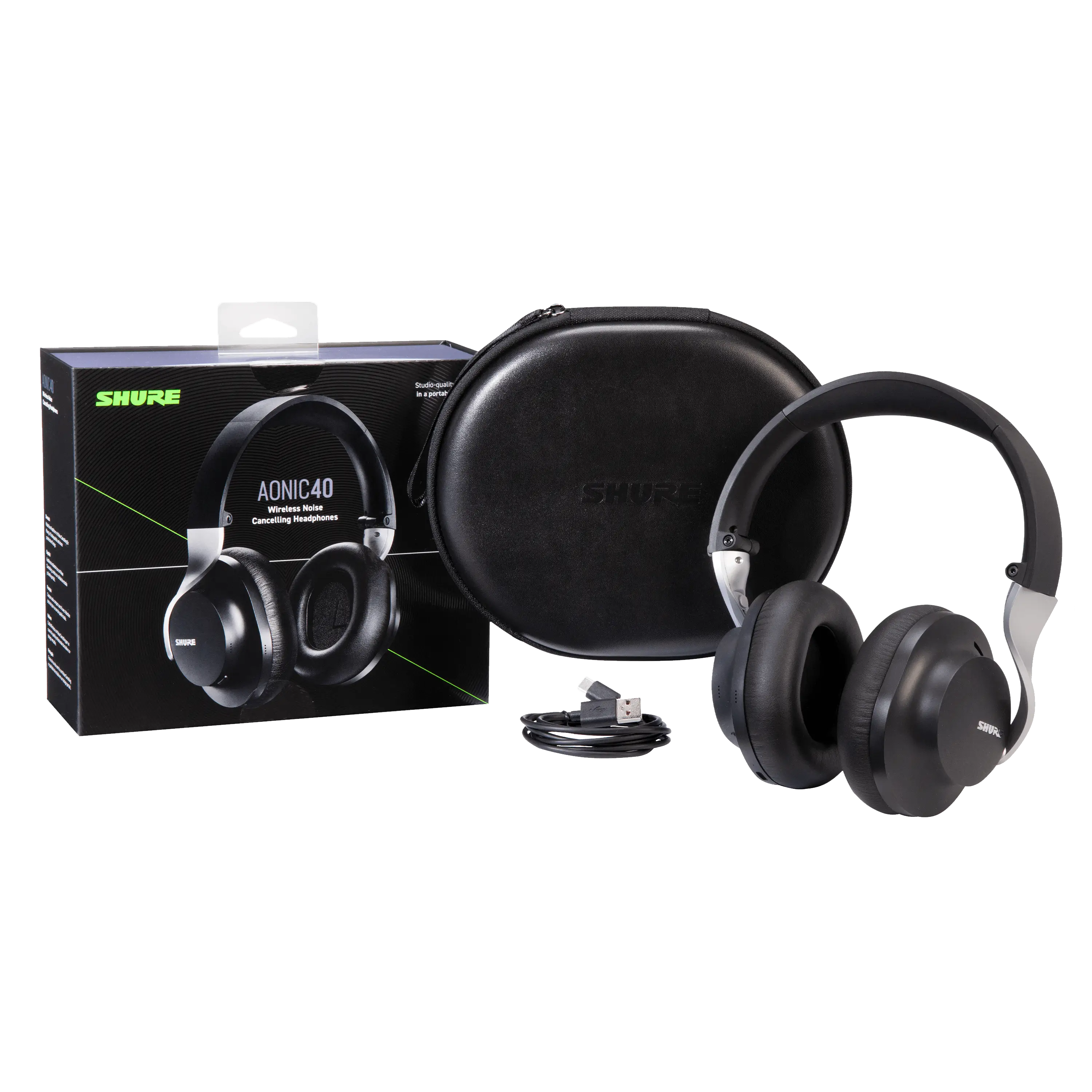
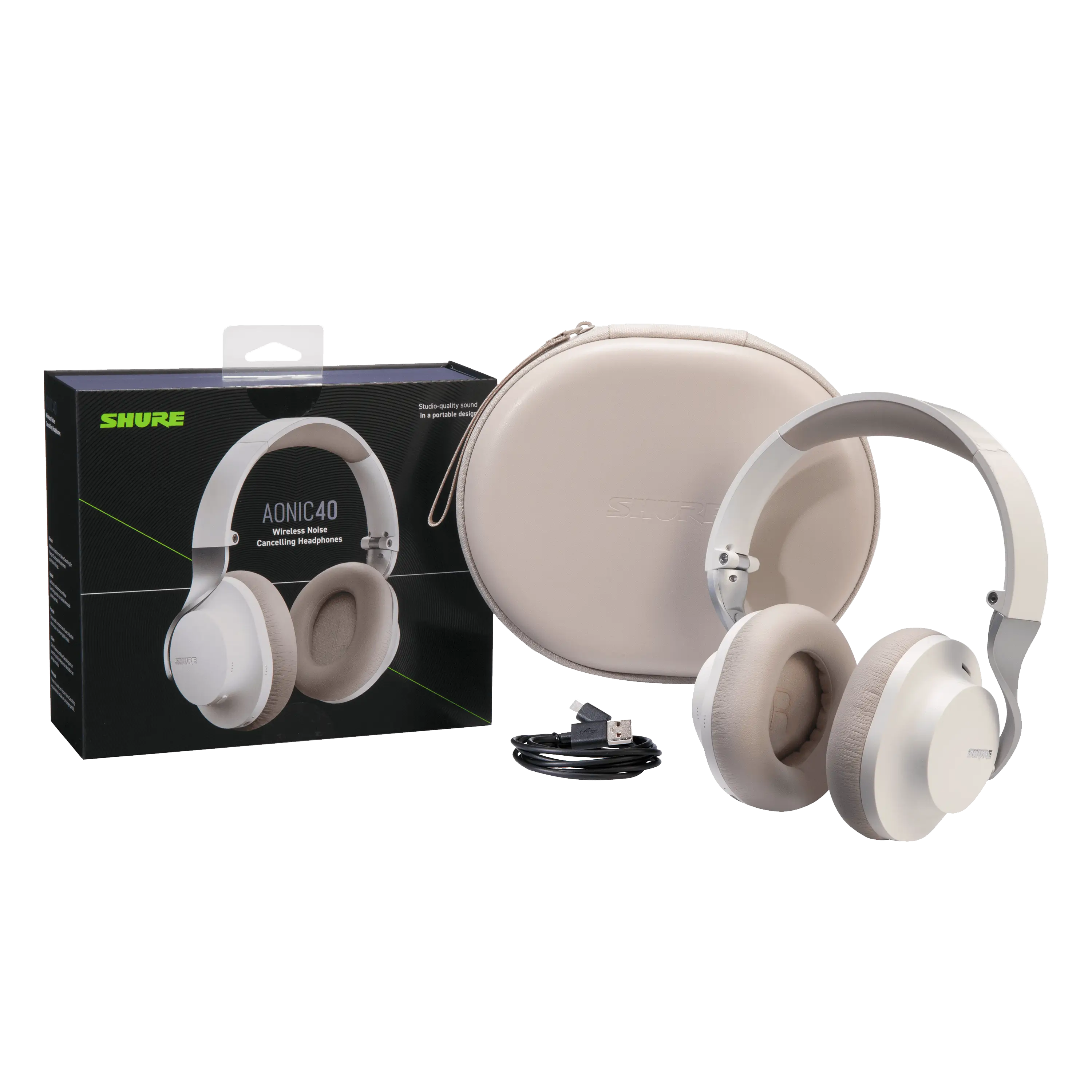
The AONIC 40 is a fold-flat, over-ear noise-cancelling headphone documented in Shure's U.S. launch materials and its model-specific SBH2240 guide. That matters because it is now an earlier reference, not a fresh current-line purchase: the former U.S. product page redirects to the manual, the U.S. category checked for this review does not list it, and Shure's European product page labels it discontinued. The U.S. launch release confirms that Shure sold the AONIC 40 in Black and White/Tan. This review treats those as finish variants of the same headphone design; it does not infer a U.S.-specific retail suffix from a European SKU.
Bluetooth multipoint and ANC live in the same documented plan
Shure's SBH2240 guide says Bluetooth multipoint keeps two devices connected at once and receives their inputs alternately. That supports a practical phone-and-computer workflow when the listener wants to leave both sources paired. It is not a promise that calls, music, or other audio from the two devices will be mixed together. The guide's pairing directions also make clear that the source device must be paired and discoverable; a buyer should confirm that the intended computer and phone can connect and switch in the way their routine requires.
For noise control, Shure describes three digital ANC settings and an Environment Mode. The guide identifies Light, Normal, and Max ANC levels and shows both an earcup control and an app control path. These are documented controls, not independent evidence that one setting will block a particular aircraft, office, or street noise better than another headphone. This site has not measured attenuation or tested the AONIC 40 in a room, on a commute, or in flight. Seal, glasses, hair, fit, and sensitivity to pressure remain personal variables that a model sheet cannot resolve.
Shure's U.S. announcement states up to 25 hours of battery life with ANC turned on, and the manual repeats a 25-hour headline while describing quick charge as up to five hours of use after 15 minutes of charging. The available material does not set out a full test protocol for codec, playback level, call use, or temperature. The finder uses 25 hours only as the maker-stated ANC-on maximum for the Bluetooth listening arrangement. It does not predict the remaining capacity of an old-stock or used battery, and the headline should not be transferred to the separate cable inputs.
Analog and USB-C are useful, separate routes
The model guide documents two wired input paths: a 3.5 mm analog cable and USB-C digital audio. Shure's launch release lists a 3.5 mm audio lead and USB-C cable in the package; the guide's accessory table identifies the analog lead as a 2.5 mm-to-3.5 mm cable. USB-C can charge the headset and carry digital audio, while the PLAY app's conference mode can route the headset microphone and speakers for two-way calls. Do not confuse that USB-C conferencing route with Bluetooth multipoint.
There are important unknowns. The reviewed manual does not say whether ANC remains available over the analog cable or USB-C route, does not provide a runtime for ANC over either wired route, and does not confirm that the analog lead continues to play when the headphone is off or depleted. The finder therefore records only the documented cable and digital-input capabilities; it does not match AONIC 40 to an essential powered-analog-ANC or battery-free-playback requirement. This is a limit of the evidence, not proof that the electronics cannot behave that way.
What the model numbers can—and cannot—tell you
Shure's guide identifies the headphone model as SBH2240, gives a 40 mm dynamic driver, and lists a weight of 313 g. The Shure AONIC 50 Gen 2 review on this site documents a 50 mm driver and 334 g weight for that separate model. Those published differences can help a shopper compare listed hardware and mass, but they do not establish that one will sound fuller, cancel more noise, or feel better on a particular head. Those judgments need listening and fit evidence the source documents do not provide.
The official Shure product page identifies Black and White/Tan as distinct finish selections, and the original manufacturer images below preserve the colors. The image set shows a retail presentation with a case and cables; it is not proof that a particular used or open-box listing still includes those items. Finish is cosmetic in the evidence reviewed here, so both are covered by one capability assessment, but the exact offered package remains a seller-by-seller check.
Earlier-model buying checks deserve extra attention
The best reason to consider this model in a comparison is narrow and factual: it combines documented Bluetooth ANC, two connected Bluetooth devices, an ANC-on 25-hour maximum, a physical analog input, and USB-C digital audio in one compact fold-flat design. Its strongest limitation is equally concrete: the U.S. product route no longer presents a current offer, and an old battery's present condition cannot be inferred from the original rating. Shure's European page calls the product discontinued, while the historical U.S. release confirms its domestic launch. This is why the library marks it earlier and why no copy here claims current availability.
If evaluating a seller's item, verify the model label SBH2240, the finish actually pictured, and whether the listing is the standard AONIC 40 rather than a different AONIC family or an unrelated adapter bundle. Ask what is included: the original package description names a zippered protective case, analog cable and USB-C cable. For a previously owned or older unit, check charge retention, both earcups, folding joints, pad wear, the app's Bluetooth connection behavior, the seller's return window, and any remaining warranty or service terms. No price, in-stock claim, battery test, or current official U.S. offer is asserted by this assessment.
In short, the AONIC 40 remains a useful earlier comparison for a buyer who specifically values documented Bluetooth multipoint and a 25-hour maker-rated ANC-on maximum. It is a poor evidence-based match if the requirement depends on confirmed cable-mode ANC, passive listening after power loss, or confidence in an individual old battery. Compare its exact operating plan and seller condition rather than reading a launch headline as a promise about a particular unit.
Key specifications
Key details at a glance
| Fit | Over-ear / around-ear |
|---|---|
| Active noise cancellation | Yes |
| Maximum continuous music playback (ANC on) | 25 hours |
| Headset weight | 313 g |
| Bluetooth version | 5 |
| Bluetooth audio codecs | aptX / aptX HD / AAC / SBC |
| Simultaneous Bluetooth devices | 2 |
| Analog audio input | 3.5 mm analog audio through the included 2.5 mm-to-3.5 mm cable |
| Analog cable included | Yes |
| In the box | Protective zippered carrying case / 3.5 mm audio cable (2.5 mm headphone plug to 3.5 mm source plug) / USB-C charging/audio cable |
Use the exact model’s instructions for operating limits, supplied equipment and version differences.
Sources for this review
Sources for this assessment
- Shure U.S. AONIC 40 launch release
- Shure AONIC 40 / SBH2240 user guide
- Shure Europe AONIC 40 product page, including regional finish SKUs and discontinued label
- Former Shure U.S. AONIC 40 product route (now redirects to the model guide)
- Shure U.S. headphone category; current raw HTML presents a heading but no server-rendered product cards
Check this model against your routine
Use the finder to test documented connection, ANC and battery requirements together. A match is not proof of personal comfort or measured quiet.